
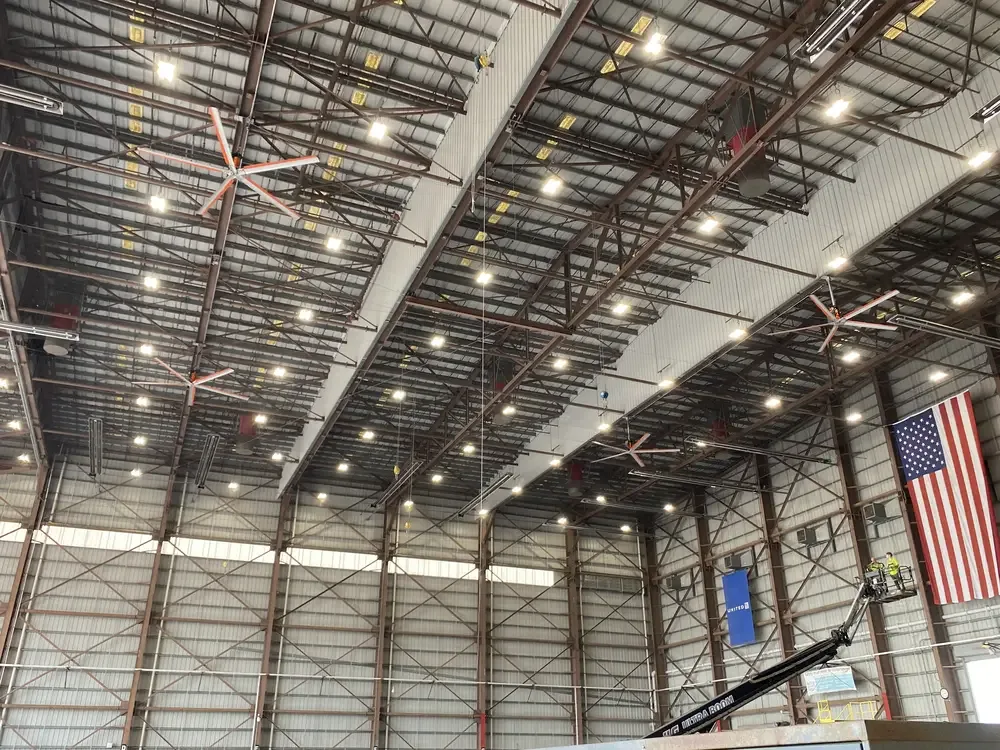
Two submittals can show the same CFM per watt and still have different efficiency ratings. AMCA's own example uses fans with matching airflow-per-watt numbers and different Ceiling Fan Energy Index scores [1]. When you compare HVLS fans, find out which model, test method and speed each number came from.
What each number measures
CFM per watt is airflow divided by electrical input at one operating point. It's handy, but fan speed, blade shape and how the results get averaged all change the comparison.
CFEI compares the fan's measured input power with a defined reference fan at a matching test condition [1][2]. Higher is better: less power for the job than the reference. It's a different calculation from CFM/W, and it follows the federal test procedure. AMCA's example explains the difference. It doesn't promise a power bill on any particular job.
Know which class the fan falls in
DOE's Appendix U calls a ceiling fan "large-diameter" when its blade span is over 7 feet, measured to the outermost reach of the blades. Belt-driven and highly decorative fans are excluded [8]. A catalog calling something "HVLS" doesn't settle the federal class.
Appendix U has other categories too, including high-speed belt-driven fans that also get CFEI testing. Directional fans, floor fans, exhaust fans and air handlers can fall under different procedures and metrics [3][8]. Pin down the class before you compare ratings or apply a minimum.
Ask for both test speeds
When we checked eCFR on November 10, 2026 (Title 10 current through November 6), 10 CFR 430.32(s)(2)(ii) required covered large-diameter fans to hit at least 1.00 CFEI at high speed and at least 1.31 at 40% speed, or the nearest available speed that isn't below 40% [9]. Those are two separate numbers, and you want both.
Section 3.5 of Appendix U tests at both points using AMCA 208-18. Power is measured across all phases and includes every power-drawing part of the fan as the procedure defines it [8]. You can't rebuild that rating by dividing catalog airflow by the motor nameplate watts, especially on a VFD fan.
DOE keeps the regulations on one page [7]. AMCA's October 21, 2025 update covers a proposed tightening that was withdrawn [3]. That's history, not the rule. Check the federal text, which products it covers and its exceptions when you write the spec. Local building code is a separate check.
Make the bid sheet line up
Ask for the exact model and blade span, blade or airfoil option, tip style and control package. Get the declared CFEI with its test procedure and speed, plus airflow and input power at that same point. If a bidder leaves something blank, mark it incomplete. Don't fill it in with a guess.
If the spec calls for independent ratings, check what the fan's AMCA Certified Ratings Program listing actually covers [4]. The certification mark doesn't mean the fan suits every building.
Mounting height, racking, obstructions, controls and run hours belong in the comparison too. No lab index captures them.
Measure the installed result on its own
CFEI won't tell the owner how evenly air reaches the crew, how much stratification drops, or whether the floor will feel better. Set acceptance criteria for what the building actually needs, like air speed where people work or temperature from floor to ceiling.
ASHRAE Standard 55-2023 covers thermal comfort [5]. Standard 62.1, in its 2025 edition when we checked, covers ventilation and indoor air quality [6]. Your jurisdiction may use an older edition. A CFEI score answers neither one.
Put the rated efficiency comparison in the equipment submittal and the installed measurements in the commissioning plan. The owner needs both to judge the purchase.
Sources
[1] AMCA International, Introducing Ceiling Fan Energy Index (CFEI), published June 4, 2024 (adapted from 2021 AMCA publication): https://www.amca.org/educate/articles-and-technical-papers/amca-inmotion-articles/introducing-ceiling-fan-energy-index-cfei.html
[2] AMCA International, Ceiling Fan Energy Index: Calculator and Resources and Large Diameter Ceiling Fans: https://www.amca.org/amca-members-area/member-tool-kit/ceiling-fan-energy-index.html ; https://www.amca.org/advocate/energy-efficiency-and-system-performance/ldcf/
[3] Michael Ivanovich, AMCA International, 2025 Update on U.S. Fan-Efficiency Codes and Regulations, published October 21, 2025: https://www.amca.org/educate/articles-and-technical-papers/amca-inmotion-articles/2025-update-on-u.s.-fan-efficiency-codes-and-regulations.html
[4] AMCA International, Certified Ratings Program: https://www.amca.org/certify/
[5] ASHRAE, Standard 55-2023, Thermal Environmental Conditions for Human Occupancy: https://www.ashrae.org/technical-resources/bookstore/standard-55-thermal-environmental-conditions-for-human-occupancy
[6] ASHRAE, Standard 62.1-2025, Ventilation and Acceptable Indoor Air Quality: https://www.ashrae.org/technical-resources/bookstore/standards-62-1-62-2
[7] U.S. Department of Energy, Ceiling Fans (current regulations hub): https://www.energy.gov/cmei/buildings/ceiling-fans
[8] eCFR, 10 CFR Part 430, Subpart B, Appendix U, especially sections 1.12, 3.5 and 5, checked November 10, 2026: https://www.ecfr.gov/current/title-10/chapter-II/subchapter-D/part-430/subpart-B/appendix-Appendix%20U%20to%20Subpart%20B%20of%20Part%20430
[9] eCFR, 10 CFR 430.32(s)(2)(ii), federal CFEI thresholds for large-diameter ceiling fans, checked November 10, 2026 (eCFR Title 10 current through November 6, 2026): https://www.ecfr.gov/current/title-10/chapter-II/subchapter-D/part-430/subpart-C/section-430.32