
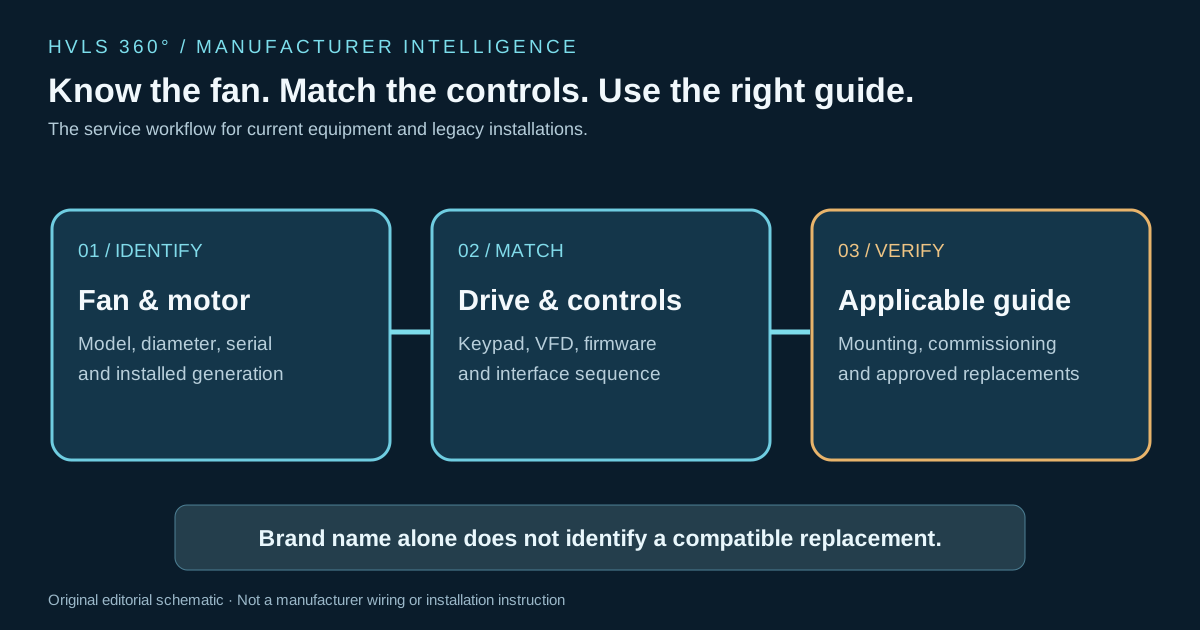
A Powerfoil 6 job takes more than a circle on the ceiling plan. The electrical variant, the structural attachment, the control package and the fire shutdown wiring all change what your crew has to do. Big Ass Fans' installation guide spells out what to check before you mobilize [2]. Everything here comes from the manual and the product page. HVLS 360° has not independently tested the fan.
Settle the controls when the fan is ordered
Big Ass Fans lists eight diameters from 8 to 24 feet, six airfoil options, an onboard VFD, a motor with a helical gearbox, and a wired OLED wall controller in the box. The optional BAFCon controls add multi-fan and building-controls features, and the company says that upgrade can run up to 24 fans [1].
On a multi-fan site, find out before the submittal is done whether the owner wants group control, temperature-based operation or a tie-in to the building system. The order and your install scope both need to name the control setup.
Match the power to the fan you bought
Revision D of the guide, dated November 19, 2025, lists the supply configurations, minimum circuit ratings and dedicated overcurrent protection for each fan [2]. Plan the feeder and disconnect from that, the approved submittal and the nameplate.
The manual includes 575 to 600 V three-phase. The online configurator we checked on November 10, 2026 showed 200 to 250 V single-phase, 200 to 250 V three-phase and 400 to 480 V three-phase [1][2]. That gap doesn't tell you whether a 600 V unit can still be ordered. Go by the configuration on the purchase order, not either list.
Factory wiring and testing are described on the product page [1]. The crew still needs a defined scope for feeder routing, control cable, connections and functional checks.
Look hard at what it's hanging from
The product page lists I-beams, bar joists, Z-purlins and solid beams as possible mounting points [1]. The guide adds the rules that drive the layout: bar joists get the prescribed angle-iron assemblies, no swapping in strut channel without an engineer, and never hang the fan from a single purlin, truss or bar joist [2].
Find the actual members and the approved attachment before you lock in the centerline and extension length. Put obstructions, lights, fan spacing and the structural connection on the plan. A blade-span circle tells the crew nothing about how the fan mounts.
Decide who does the fire shutdown
The guide shows a normally open fire relay and an optional normally closed one. Both stop the fan and show a fault at the controller, and the guide gives the terminals and relay details for each model [2].
Bring that drawing to the meeting with the electrical and fire alarm trades. Settle who supplies and wires each piece, whether the circuit needs supervision, and who witnesses the test. "Provide fire alarm shutdown" on a scope sheet isn't enough to split the work or prove it works.
Hand off the maintenance with the fan
Big Ass Fans says the gearbox is lubricated for life [1]. The fan still needs inspecting. The guide's annual checklist covers safety cables, mounting hardware, hub parts, airfoils, oil leaks and unusual noise. It also says when to take the fan out of service and call the manufacturer, including certain leaks, structural damage and a grinding noise [2].
Leave the owner the right guide, the model and serial numbers, the controller details and your commissioning record. Agree on who does the yearly inspection and how they'll get up there. If nobody settles that, the maintenance section never gets followed after your crew leaves.
Sources
[1] Big Ass Fans, Powerfoil 6 HVLS Fan (product page; reviewed November 10, 2026): https://bigassfans.com/powerfoil-6-hvls-fan/
[2] Big Ass Fans, Powerfoil 6 Installation Guide, Rev. D, November 19, 2025; pp. 1–4, 21–24 and 26–31 (current link recovered from the manufacturer support page on November 11, 2026): https://bigassfans.widen.net/view/pdf/7t3u2vurlm/powerfoil6-install-guide.pdf