A lift that reaches the bottom of the fan can still leave you short of the top mounting connection. It can also be too wide for the aisle you need to drive it down. Fan diameter and ceiling height only start the access survey. Walk the route and every work position before you book the rental.
OSHA's scissor-lift guidance covers fall protection, stability and positioning [1]. On a fan job, that means the floor, the platform load, everything overhead and the plant's own traffic all go into the estimate along with lift height.
Measure where the crew actually works
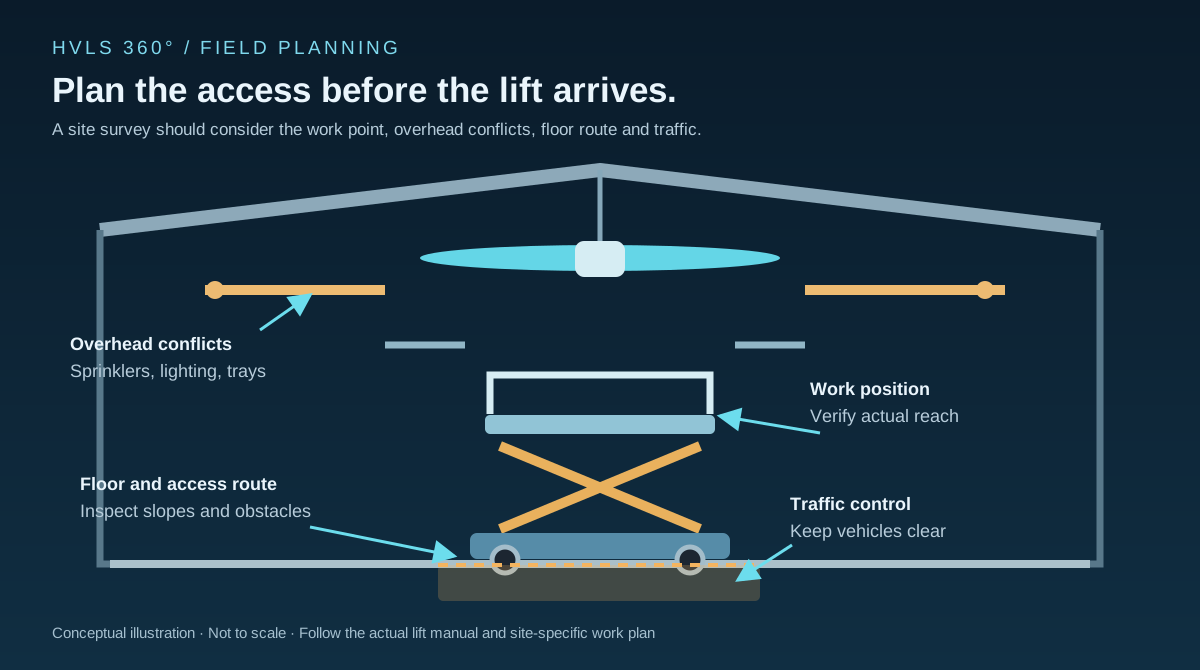
Write down the height and location of the mounting connection, motor, blade attachments and electrical work. The operator needs a platform position that works for each one. OSHA says to stand on the platform and keep the work within easy reach. Climbing the guardrails isn't an access plan [1].
Measure doors, aisles and the path around machinery. Check the lift model's platform size, capacity and operating limits in its manual. Rated height doesn't prove you can reach the connection or get the machine there.
Walk the floor the whole way
Trench covers, drains, dock plates, joints, slopes and debris all affect how the lift moves and how steady it sits. OSHA calls for firm, level ground away from holes, drop-offs and similar hazards [1]. Check the travel route and every spot where you'll raise the platform.
Check the exact machine's rules on driving while elevated. OSHA notes that manufacturers commonly restrict it [1]. Some allow it and some don't, so go by the manual for the lift you rented.
Everybody on the platform counts toward the load, along with tools, fan parts and anything else up there. Figure out whether the hub or motor needs its own hoisting method. A scissor lift isn't a crane.
Work it out with the plant
Sprinkler pipe, lights, cable tray and overhead doors can crush or pin someone on the platform. Live electrical and moving equipment add hazards at the work spot and along the route [1].
In a running warehouse, agree with operations on how traffic stays away from the lift before you go up. Forklifts shouldn't be able to wander into the work zone. A spotter helps in tight spots, but doesn't replace a trained operator or a closed-off zone.
Follow the rules for the lift you're using
OSHA stresses guardrails, trained workers and safe habits on the platform [1]. Check fall protection and operating rules against the lift's manual, the regulations that apply and your company's hazard assessment. Don't carry a boom-lift rule over to every scissor-lift job without checking the machine and the task.
Outside, check the machine's wind rating and limits. OSHA calls wind a serious stability concern [1]. Wind limits vary by machine. Go by the rating on the one you rented.
Put access in the bid
Keep the work heights, clearances, route, floor conditions and planned platform loads with the estimate. Name the lift model, the trained operator, the inspection requirements, the traffic controls and any separate hoisting plan. You still need a hazard assessment for the specific lift and job.
If the lift won't fit down the aisle, can't reach the attachment or can't carry the planned load within its rating, change the method and the rental budget before the crew shows up.
Sources
[1] U.S. Occupational Safety and Health Administration, Working Safely with Scissor Lifts, OSHA 3842: https://www.osha.gov/sites/default/files/publications/OSHA3842.pdf