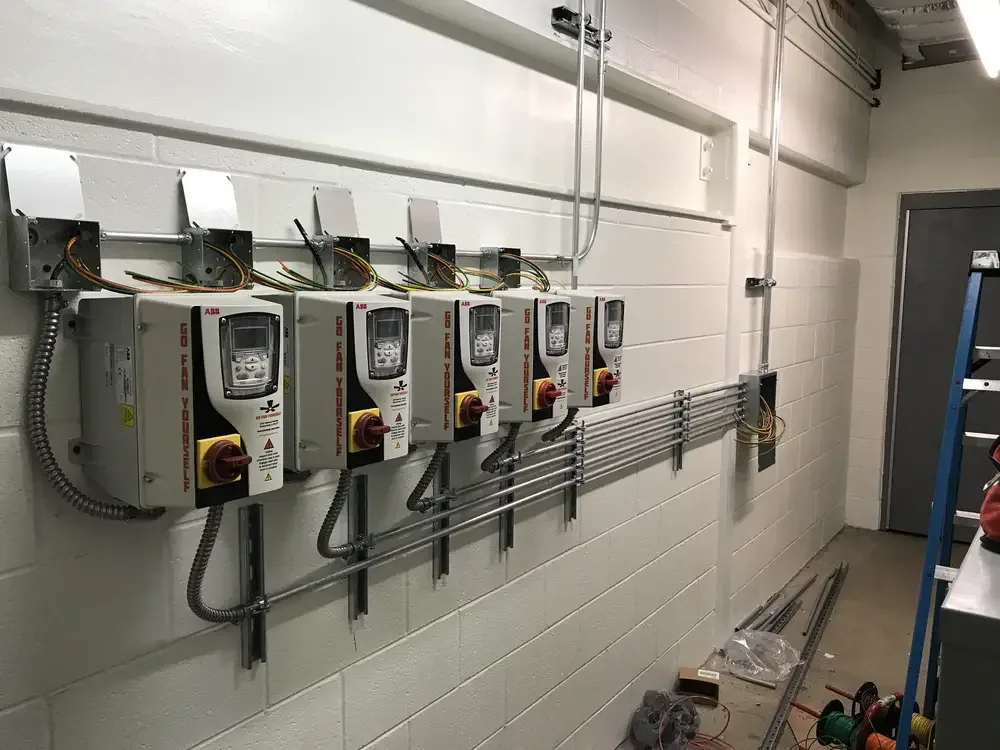
Before you order a replacement drive for a Go Fan Yourself job, find out exactly what's on the ceiling and what's running it. VividAir's current Z-Tech and TAZ documents sit right next to older GFY paperwork that may still cover fans in service [1][2][3]. The product name alone won't get you the right wiring drawing or part.
Z-Tech paperwork covers several years
VividAir's Z-Tech page lists nine standard diameters from 8 to 24 feet, a pitched-blade design for warehouses and manufacturing, and a Z-Chill upgrade [2]. The documents include a January 2023 installation and technical operations guide, a November 2025 spec sheet and an October 2026 sell sheet.
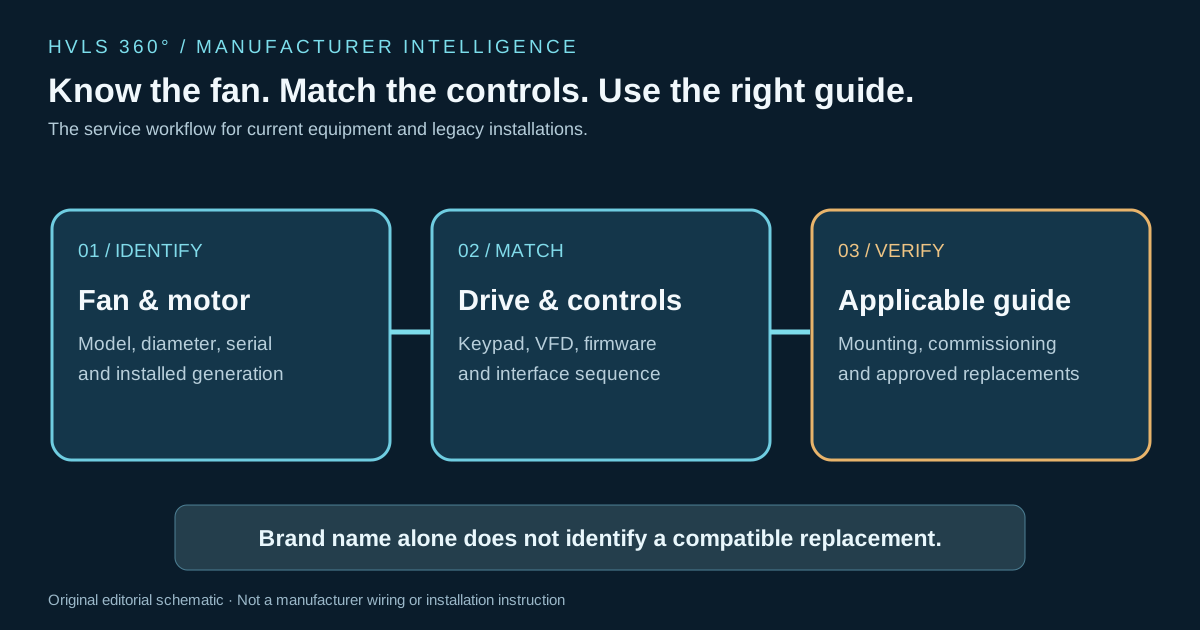
Write down the installed model and control hardware before you service off any of those. What's for sale today may not match what shipped years ago. Compare the labels, revisions and job submittal against the right technical guide before you swap a drive, keypad or motor part.
The older GFY Z-Tech page describes ABB components and a Dodge Quantis Z-Tech drive system [3]. That helps you identify an older install. It doesn't tell you what drive, firmware or controls are in a current VividAir Z-Tech.
TAZ needs its own layout
VividAir sells the TAZ for aisles, mezzanines and obstructed ceilings, in 36-inch and 72-inch sizes, with a separate guide for each [1]. An aisle job needs a discharge direction, a mounting orientation and a list of everything in the air's path. A max airflow number won't tell you whether it can stand in for a 20-foot overhead fan.
VividAir advertises up to 135 feet of linear cooling coverage and 75,200 CFM for the family [1]. We haven't tested those numbers. Ask which size, speed and test setup they came from before you compare coverage.
The January 2023 download on the product page is labeled for the 72-inch model, but the guide inside carries "7ft" headings, as our TAZ field guide covers. Check it against the unit you actually have instead of trusting the link label.
Trace the controls, not just the fan
VividAir's current Z-Tech page names Navigator for central control of single fans and groups [2]. Neither that nor the old ABB references tell a service tech what's actually on a given site.
Write down the keypad, controller, drive and motor labels. Include communications wiring and any tie-in to the building system or fire alarm. Voltage and horsepower alone won't tell you whether a motor matches, whether a control combination is approved, or how the fan should stop and restart.
On a site with older GFY fans and newer VividAir fans, keep those records by fan or by control group. If you can't identify a hardware revision, call the manufacturer before you order parts.
Tie performance claims to the job
VividAir's catalog includes the Z-Tech, Z-Tech3, TAZ and Z-Chill [4]. Get the test method and conditions behind any coverage or efficiency claim before you compare them.
For comfort, ask about air speed where people work and the conditions behind any perceived-cooling number. For destratification, ask for temperatures at the ceiling and the work floor, before and after. Comparing max airflow numbers from different fans answers neither one.
Before you roll a truck, pull together the fan ID, the right manual, drive and motor data, controller revisions, the mounting detail and the control sequence. Add the commissioning and maintenance instructions for that setup. That's a better start than a brand name and a photo of the keypad.
Sources
[1] VividAir, TAZ product page, including 36-inch and 72-inch technical guide links: https://vividairmovement.com/product/taz/
[2] VividAir, Z-Tech product page, including current product literature and technical guides: https://vividairmovement.com/product/z-tech/
[3] Go Fan Yourself, Z-Tech product page, including historical ABB system references: https://gofanyourself.com/products/z-tech-fan/
[4] VividAir, Current products and product families: https://vividairmovement.com/products/