
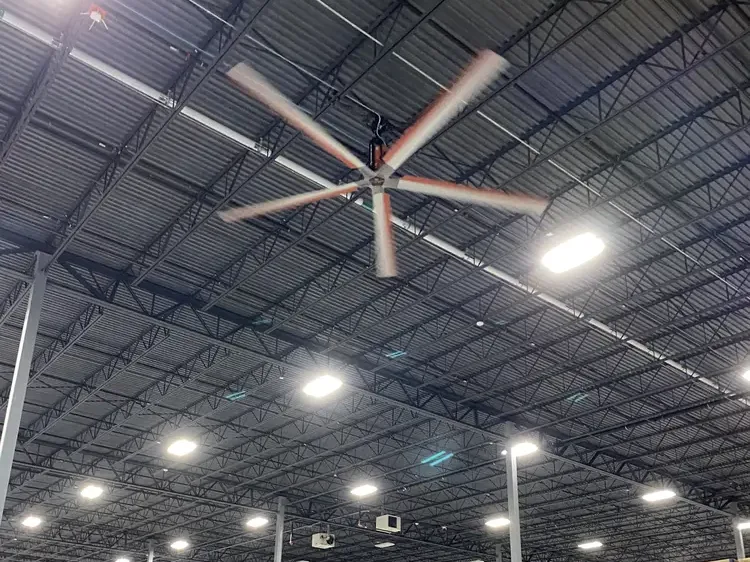
A lot of building owners shut their big fans off in October. In a tall heated building, that's leaving money on the table.
Heated air rises and stacks up under the roof deck. A common rule of thumb is about half a degree Fahrenheit warmer for every foot of height [1]. In a building with a 30-foot ceiling, that works out to roughly 15 degrees between the floor and the roof deck. Measured gaps in big warehouses have run higher. One distribution center reported 30 degrees before fans went in [2]. Your heaters keep running to warm a space while the heat sits up where nobody works.
How to run the fans in winter
Run them slow. Big Ass Fans recommends 10 to 30 percent of maximum speed, in the forward direction, with air at the work level kept to about 30 feet per minute or less so nobody feels a draft [2]. That gently mixes the warm air down without the wind-chill effect you want in summer. Reversing the fans at higher speed uses more energy and can push more heat out through the roof [2].
Follow your fan maker's winter settings if they give them. Some controls have a winter mode built in.
What you get back
People on the floor feel warmer, the heaters cycle less, and the gas or electric bill comes down. How much depends on the building. One facilities engineer puts savings from cutting stratification at around 15 to 20 percent of annual energy [1], and manufacturers report results all over the map, so measure your own. Take temperatures at a few heights before and after, and watch the heating bill.
There's no second system and no extra equipment. It's a slow setting on a fan you already own.
Sources
[1] James Piper, P.E., How To Fight Air Stratification in Conditioned Facilities, FacilitiesNet, September 21, 2018: https://www.facilitiesnet.com/hvac/article.aspx?id=17985
[2] Vicky Broadus (writing for Big Ass Solutions), Why Heating Bills are Too High in DCs and Warehouses, MH&L, February 8, 2016: https://www.mhlnews.com/facilities-management/article/22051294/why-heating-bills-are-too-high-in-dcs-and-warehouses